Showing posts with label Adam Gilchrist. Show all posts

Tuesday, 11 January 2011

Are Australia ready for a World Cup defence?

With the Ashes over, Australia are now turning their attention towards the One-Day series with England and the World Cup in India, Sri Lanka and Bangladesh which follows the series in February. With World Cup squads having to be named in a week’s time, Australia’s selections for the opening one-day games against England have given us a few clues surrounding what team will be on the plane to the sub-continent.

Starting with the openers, it would only take a serious injury for Shane Watson not to open the batting. The limited overs format suits his hard hitting style and he will have to perform if Australia are to retain the trophy they have held for 12 years.  His medium pace bowling could also come in handy on the slow, low pitches that can be found on the sub-continent.

Since Adam Gilchrist burst onto the international scene, many teams now have a wicket-keeper as their opening batsman in the 50-over format. Since Gilly’s retirement Australia have continued this tradition and this doesn’t seem likely to change given their recent selection. Brad Haddin is the only man in the squad who could realistically open the innings. He seems to have been given the nod over Tim Paine, although both could make the trip to Asia.

Despite his lack of form, I would be very surprised if Ricky Ponting wasn’t batting at number three when he returns from his finger injury. However, for the time being it looks as if David Hussey will take the captain’s place in the side. Hussey averages less than 30 in his 23 one-day internationals, but a good performance against England could give Ponting some sleepless nights.

The rest of the middle-order almost picks itself, with Michael Clarke, Cameron White and Mike Hussey unlikely to be dislodged before cricket’s premier tournament. The likes of Callum Ferguson and Usman Khawaja could gain places in the squad, but are unlikely to make the team unless there are injuries.
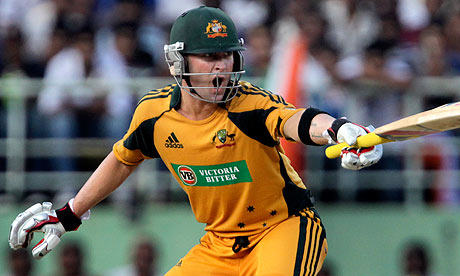
Michael Clarke will head up Australia's middle order
The make up of the rest of the team is still a mystery. Many may predict that Steve Smith will bat at seven due to his leg spin bowling, which should come in handy on the spinning wickets of the sub-continent. Whether he will take up that position for the England series is yet to be seen.

The other bowlers who have been named in the squad have everything to play for. Mitchell Johnson’s lower order batting will most probably see him into the side, whilst Shaun Tait’s pace is almost unrivalled in world cricket.
Shaun Tait should figure in Australia's World Cup bid
The third seamer’s position looks as if it will be fought out by Peter Siddle and Doug Bollinger. Despite Siddle’s impressive Ashes series, Bollinger seems to be more in favour with the selectors when it comes to the one-day game.

The one position which has gained the most headlines is that of the spinner. Nathan Hauritz’s inclusion shows that he is still on the selectors’ radar, despite him being overlooked for the Ashes series. He will fight for his position with the much maligned Xavier Doherty, who wins a place in the squad after impressing in the one-day matches against Sri Lanka, which preceded the Ashes.

With seven matches to choose the right combination of players to retain the trophy, Australia’s selectors have a big job to do. The squad they have picked shows that are willing to back players who are tried and tested, and only time will tell whether this will reap the rewards of a fourth consecutive World Cup.

This article can also be found at worldcricketwatch.com

Tuesday, 28 September 2010

Is the Twenty20 gimmick getting old?

With the impending ECB announcement that the amount of Twenty20 Cup group games in England’s domestic calendar is going to be cut from 16 to ten, many commentators have asked whether the pull of the newest form of the game is beginning to drop.

Throughout the 2010 County season, the issue of Twenty20 overkill was raised many times, with counties playing 16 group games each as appose to the usual ten. Attendances were down on previous seasons, whilst certain international games also saw less than capacity crowds. Players also complained of burnout, with some becoming injured before the season had come to an end.

This season’s competition was billed as the biggest and best so far, with more overseas players than ever before. The introduction of stars such as Herschelle Gibbs and Adam Gilchrist to the competition failed to galvanise audiences as the ECB and the various counties had hoped, and with the sheer volume of games, audiences dwindled. England’s matches against Bangladesh and Pakistan were watched by less than full stadiums as cricket supporters struggled to finance watching all the cricket that was on offer.

It wasn’t only the public who couldn’t handle the amount of games, but also the players. The likes of England Twenty20 World Cup winner Michael Lumb had their season’s cut short due to injury, whilst other players were rested so as to save them from burning out. Six extra days of cricket a year may not sound a lot, but with travelling and the enhanced warm-ups and fitness training that the modern cricketer has to go through, these six days can be the difference between a player staying fit or picking up an injury.

So is Twenty20 cricket, the format that those at the top of the game said would bring in a new mass audience, now losing its appeal?

The answer is most probably not yet, especially in countries such as India and Australia, where the IPL and KFC Big Bash have the biggest stadium and television audiences. However, in the country in which Twenty20 was formed, the draw of the shortened format is at its lowest since its inception in 2003. In the event that this pattern spreads from England’s shores, then the future of “the future of cricket” could be under threat.


This article can also be found at worldcricketwatch.com

Thursday, 11 March 2010

IPL- really the future of cricket?

When the idea of the Indian Premier League was first proposed by Lalit Modi, the whole cricket world sat up and took notice.

However, since that announcement the tournament has been less about the on-field action and more about the off-field controversy. Security fears leading to a change in venue, the banning of several high-profile players and disputes with several international boards are just some of the problems the organising committee have faced.

So now, on the eve of the third annual competition, many cricket followers are asking whether the competition that was billed as the future of cricket will ever live up to its potential.

This years IPL, or IPL 3 as it is being billed in the Indian sporting media (one of the many examples of how the sport is becoming Americanised) could be the best tournament so far, with a plethora of the world's best players taking part at some stage.

The fact that players such as Shane Warne, Damien Martyn and Adam Gilchrist have decided to prolong their careers to take part shows the appeal the competition has. Whether that appeal is the urge to play cricket at a high level or the money involved is up to debate. The fact that the Twitter accounts of Warne and Martyn have this week been inundated with reports of them taking part in different photo shoots may answer this question.


The standard of the cricket in the competition is helped by these legends of the game taking part, and the experience and expertise they pass onto the many Indian youngsters in the various franchises will become invaluable to them as they build their own careers.

However, that is all but where the good points surrounding the IPL end. The main talking points surrounding the competition are contentious to say the least, with controversy seeming to follow it wherever it goes.

The security fears that have surrounded the Modi's brainchild since its inception have caused the most controversy, with some players expressing there fears in the build-up to the 60-game tournament.

The expulsion of all Pakistani players is also an issue which has raised debate. In last year's competition there was a blanket ban on all of Pakistan's players. However, this year the majority of Pakistan's national side were available in the main player's auction and many onlookers felt that normal service would be resumed.

The fact that not one of the eleven Pakistani players who were available in the auction were snapped up by the franchises might show that the countries differences are still at the fore. The excuse of the players being unable to obtain Visa's was given, but the fact that the tournament will miss the like of Shahid Afridi and Umar Gul, two of the world's best Twenty20 cricketers, is a great shame.
So whilst India prepares itself for its biggest sporting event of the year, many back in England will be none the wiser to what is going on. That is, unless, a major off-the-field incident again steals the headlines...